जंगल से मिलने वाली गंभीर चेतावनी (इब्रानियों 3:7–19)

जंगल से मिलने वाली गंभीर चेतावनी: अपने हृदय को कठोर न होने दें – इब्रानियों 3:7–19
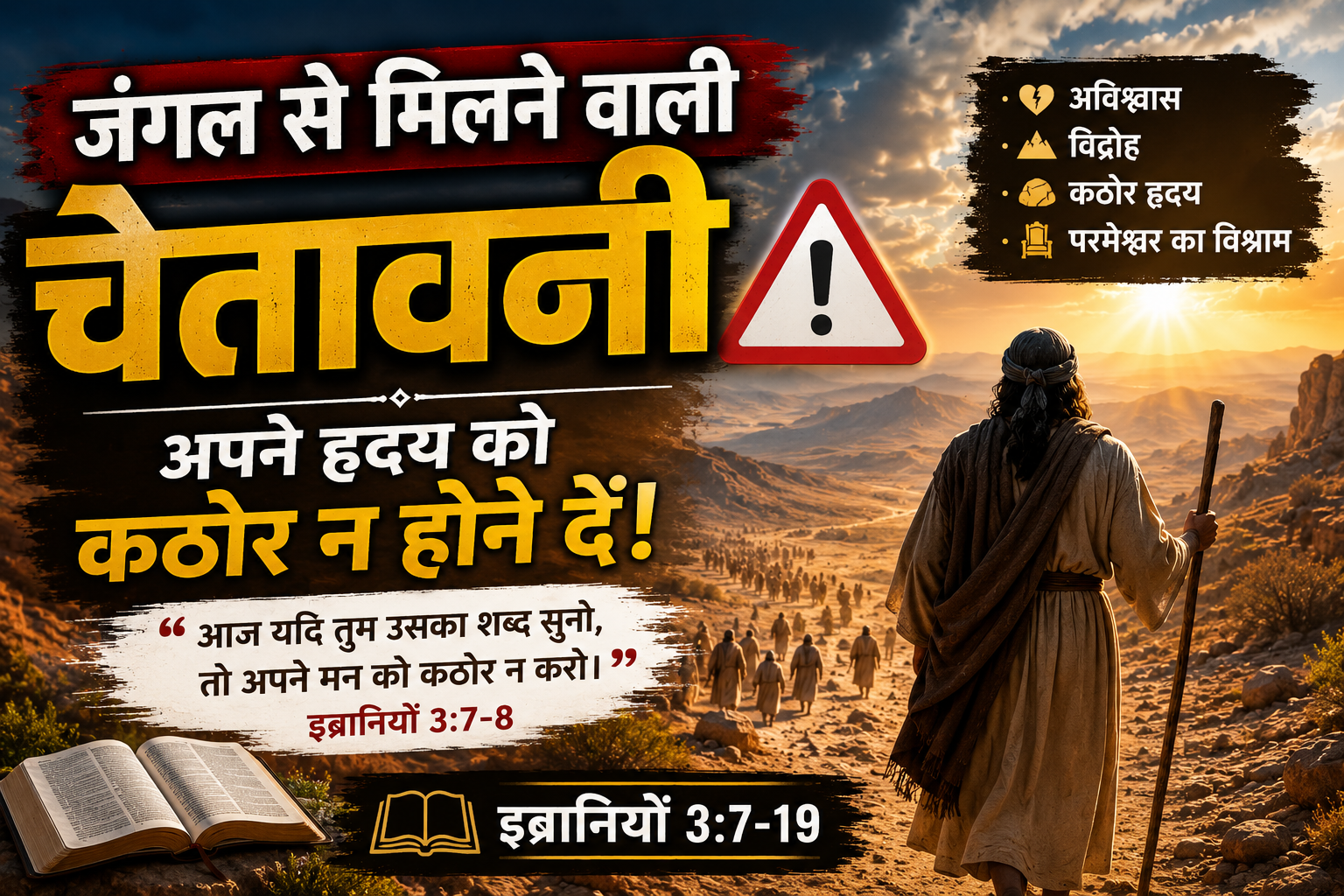
“आज यदि तुम उसका शब्द सुनो, तो अपने मन को उस विद्रोह के समय के समान कठोर न करो।”
— इब्रानियों 3:7-8

इब्रानियों का पत्र एक ओर हमें प्रभु यीशु मसीह की महानता और महिमा दिखाता है, तो दूसरी ओर हमें गंभीर चेतावनियाँ भी देता है। पिछले भाग (इब्रानियों 3:1-6) में हमने देखा कि यीशु मूसा से कहीं अधिक महान हैं। मूसा परमेश्वर के घर में एक विश्वासयोग्य सेवक था, परन्तु यीशु उसी घर के निर्माता और उसके ऊपर पुत्र हैं।

फिर लेखक एक महत्वपूर्ण बात कहता है—
“और यदि हम अपने भरोसे और आशा के घमण्ड को अन्त तक दृढ़ता से थामे रहें, तो हम उसी का घर हैं।”
— इब्रानियों 3:6

यहाँ “यदि” शब्द बहुत महत्वपूर्ण है। मसीही जीवन केवल अच्छी शुरुआत करने का नाम नहीं है, बल्कि अन्त तक विश्वासयोग्य बने रहने का जीवन है। इसी कारण लेखक इस्राएलियों के जंगल के अनुभव को हमारे सामने एक चेतावनी के रूप में रखता है। वे मिस्र की गुलामी से तो निकल आए, उन्होंने परमेश्वर के अद्भुत चमत्कार भी देखे, लेकिन फिर भी उनमें से अधिकांश प्रतिज्ञा किए हुए देश में प्रवेश नहीं कर सके। उनकी कहानी केवल इतिहास नहीं है—यह आज हर विश्वासी के लिए एक चेतावनी है।

जैसा कि पौलुस लिखता है—
“ये सब बातें उनके ऊपर उदाहरण के लिये हुईं, और हमारी शिक्षा के लिये लिखी गईं।”
— 1 कुरिन्थियों 10:11

आइए इस्राएल की गलतियों से सीखें ताकि हम भी आत्मिक रूप से भटक न जाएँ।

1. इस्राएल की सबसे बड़ी समस्या—कठोर हृदय

इब्रानियों 3:7-11

लेखक यहाँ भजन संहिता 95 का उल्लेख करता है, जहाँ परमेश्वर अपने लोगों को जंगल में हुए विद्रोह की याद दिलाते हैं।

इस्राएलियों ने अपनी आँखों से देखा था—

  • मिस्र की दस विपत्तियाँ
  • लाल समुद्र का दो भागों में बँटना
  • स्वर्ग से मन्ना
  • चट्टान से पानी
  • बादल और आग के खम्भे के द्वारा परमेश्वर की अगुवाई

फिर भी उन्होंने परमेश्वर पर विश्वास नहीं किया।

मस्सा और मरीबा की घटना

जब वे जंगल में प्यासे हुए, तो उन्होंने परमेश्वर पर भरोसा करने के बजाय शिकायत की।
“तू हमें मिस्र से क्यों निकाल लाया? क्या हमें, हमारे बच्चों और हमारे पशुओं को प्यास से मारने के लिये?”
— निर्गमन 17:3

जिस परमेश्वर ने अभी-अभी लाल समुद्र को खोल दिया था, उसी पर उन्होंने संदेह किया। बाद में कादेश में भी उन्होंने फिर वही गलती दोहराई (गिनती 20:1-13)।
समस्या प्रमाण की कमी नहीं थी।
समस्या उनका कठोर होता हुआ हृदय था।

हृदय कठोर होने का क्या अर्थ है?

कोई भी व्यक्ति एक दिन में कठोर नहीं बन जाता। यह धीरे-धीरे होता है। जब हम बार-बार परमेश्वर की आवाज़ को अनसुना करते हैं, तब हमारा हृदय कठोर होने लगता है। हर छोटी अवज्ञा अगली अवज्ञा को आसान बना देती है। धीरे-धीरे पवित्र आत्मा की समझाइश का प्रभाव कम होने लगता है।

मान लीजिए कोई व्यक्ति पहले प्रतिदिन बाइबल पढ़ता और प्रार्थना करता था। फिर उसने एक दिन छोड़ दिया। फिर एक सप्ताह। फिर कई महीने बीत गए। अब आराधना सभा में जाना भी आवश्यक नहीं लगता। पाप पहले जितना बुरा नहीं लगता। ऐसा एक दिन में नहीं हुआ। उसका हृदय धीरे-धीरे कठोर हो गया। यही आत्मिक भटकाव की शुरुआत है।

2. अविश्वास की कीमत बहुत बड़ी होती है

परमेश्वर ने कहा—
“वे मेरे विश्राम में प्रवेश न करने पाएँगे।” – इब्रानियों 3:11

कनान देश उनके लिए तैयार था। परमेश्वर उन्हें आशीष देना चाहता था। लेकिन वे अपने अविश्वास के कारण उस प्रतिज्ञा को प्राप्त नहीं कर सके। मिस्र से निकले लगभग 6 लाख से अधिक पुरुषों में से केवल यहोशू और कालेब ही प्रतिज्ञा किए हुए देश में प्रवेश कर सके (गिनती 14:22-30)। बाकी सब जंगल में ही मर गए। उन्होंने चमत्कार देखे, परन्तु विश्वास बनाए नहीं रखा।
चमत्कार हमें बचाए नहीं रखते।
विश्वास बनाए रखता है।

3. अविश्वासी हृदय से सावधान रहें

लेखक अब यह चेतावनी सीधे विश्वासियों को देता है।
“हे भाइयों, सावधान रहो, कहीं तुम में ऐसा बुरा और अविश्वासी मन न हो, जो तुम्हें जीवते परमेश्वर से दूर कर दे।” – इब्रानियों 3:12

ध्यान दीजिए— यह चेतावनी अविश्वासियों को नहीं, बल्कि भाइयों को दी गई है। यानी उन लोगों को जो पहले से मसीह के अनुयायी थे। यह चेतावनी वास्तविक है क्योंकि खतरा भी वास्तविक है।

अविश्वास अचानक नहीं आता

अधिकांश लोग एक ही दिन में परमेश्वर को नहीं छोड़ते।
यह धीरे-धीरे शुरू होता है—

  • प्रार्थना कम हो जाती है।
  • बाइबल पढ़ना छूट जाता है।
  • छोटे-छोटे पाप सामान्य लगने लगते हैं।
  • आत्मिक जीवन में आलस्य आ जाता है।
  • परमेश्वर पर निर्भर रहने के बजाय स्वयं पर भरोसा बढ़ जाता है।

इसी प्रकार व्यक्ति धीरे-धीरे परमेश्वर से दूर होता जाता है। जैसे बिना लंगर की नाव धीरे-धीरे किनारे से दूर बह जाती है, वैसे ही मसीह से जुड़े बिना विश्वासी भी आत्मिक रूप से बहने लगता है।

4. पाप का धोखा

इब्रानियों 3:13

बाइबल पाप के बारे में एक बहुत गहरी बात बताती है—
पाप धोखा देता है।
वह कहता है—

  • “बस एक बार।”
  • “किसी को पता नहीं चलेगा।”
  • “तुम इसके योग्य हो।”
  • “बाद में छोड़ देना।”

लेकिन हर समझौता अगले समझौते को आसान बना देता है। इब्रानियों 11:25 बताता है कि पाप का सुख क्षणिक है।
और 1 यूहन्ना 2:17 कहता है—
“संसार और उसकी अभिलाषाएँ मिटती जाती हैं; परन्तु जो परमेश्वर की इच्छा पर चलता है वह सदा बना रहता है।”

पाप थोड़े समय का आनंद देता है, लेकिन अंत में विनाश लाता है।

एक मछुआरा काँटे को स्वादिष्ट चारे के अंदर छिपा देता है। मछली केवल चारा देखती है, काँटा नहीं। ठीक वैसे ही पाप अपने परिणामों को छिपाकर आकर्षण दिखाता है। जब तक सच्चाई समझ आती है, तब तक व्यक्ति फँस चुका होता है।

5. हमें एक-दूसरे की आवश्यकता है

परमेश्वर नहीं चाहता कि कोई विश्वासी अकेले आत्मिक जीवन जीए। इसलिए वह कहता है—
“प्रतिदिन एक-दूसरे को समझाते और उत्साहित करते रहो।”- इब्रानियों 3:13

जब विश्वासी एक-दूसरे को प्रोत्साहित करते हैं—

  • विश्वास मजबूत होता है।
  • परीक्षा का सामना करना आसान होता है।
  • निराशा कम होती है।
  • हृदय परमेश्वर के प्रति कोमल बना रहता है।

इसी कारण इब्रानियों 10:24-25 हमें संगति और सभा को न छोड़ने की शिक्षा देता है।

आज हम किसी को—

  • एक फोन कॉल,
  • एक संदेश,
  • एक बाइबल पद,
  • या एक छोटी-सी प्रार्थना के द्वारा भी प्रोत्साहित कर सकते हैं।

हो सकता है आपकी एक बात किसी के विश्वास को टूटने से बचा ले।

6. अन्त तक दृढ़ बने रहें

लेखक फिर कहता है—
“यदि हम अपने आरम्भ के भरोसे को अन्त तक दृढ़ रखें, तो हम मसीह के सहभागी हैं।” इब्रानियों 3:14

मसीही जीवन केवल शुरुआत करने का नहीं, बल्कि अन्त तक विश्वासयोग्य बने रहने का जीवन है।
यीशु ने भी कहा—
“जो अन्त तक धीरज धरे रहेगा वही उद्धार पाएगा।”
— मत्ती 24:13

यहोशू और कालेब—दृढ़ विश्वास का उदाहरण

जब पूरा इस्राएल डर गया, तब केवल दो व्यक्ति विश्वास में दृढ़ रहे— यहोशू और कालेब।
– उन्होंने भी वही दैत्य देखे।
– वही कठिनाइयाँ देखीं।
लेकिन उन्होंने परिस्थितियों से अधिक परमेश्वर के वचन पर भरोसा किया।
– और अन्त में वही प्रतिज्ञा के देश में प्रवेश कर सके।
– विश्वास कठिनाइयों को नकारता नहीं।
– विश्वास यह मानता है कि परमेश्वर हर कठिनाई से बड़ा है।

7. विश्वास और आज्ञाकारिता साथ-साथ चलते हैं

अध्याय के अन्त में लेखक एक महत्वपूर्ण सत्य बताता है। इब्रानियों 3:18 में इस्राएलियों की असफलता का कारण आज्ञा न मानना बताया गया है। और इब्रानियों 3:19 में वही कारण अविश्वास कहा गया है।
क्यों?
क्योंकि सच्चा विश्वास हमेशा आज्ञाकारिता उत्पन्न करता है।

याकूब लिखता है—
“विश्वास यदि कर्म न हो तो अपने स्वभाव में मरा हुआ है।”
— याकूब 2:17

पौलुस ने भी लिखा—
“विश्वास की आज्ञाकारिता।”
— रोमियों 1:5

इसी कारण इब्रानियों 5:9 कहता है—
“वह उन सब के लिये जो उसकी आज्ञा मानते हैं, अनन्त उद्धार का कारण हुआ।”

जंगल की घटना से मिलने वाले महत्वपूर्ण सबक

  • केवल चमत्कार देखने से विश्वास मजबूत नहीं रहता।
  • कठोर हृदय धीरे-धीरे बनता है।
  • पाप हमेशा पहले धोखा देता है, फिर नष्ट करता है।
  • हर विश्वासी को अपने विश्वास की रक्षा करनी चाहिए।
  • आत्मिक संगति हमें भटकने से बचाती है।
  • सच्चा विश्वास अन्त तक आज्ञाकारिता में बना रहता है।

अपने आप से ये प्रश्न पूछें

  • क्या मैं आज भी परमेश्वर की आवाज़ सुन रहा हूँ?
  • क्या मेरा हृदय किसी क्षेत्र में कठोर हो गया है?
  • क्या मैं किसी पाप के धोखे में जी रहा हूँ?
  • क्या मैं प्रतिदिन किसी भाई या बहन को प्रोत्साहित करता हूँ?
  • क्या मैं अन्त तक यीशु के साथ बने रहने का निश्चय रखता हूँ?

परमेश्वर आज भी कहता है—
“आज यदि तुम उसका शब्द सुनो, तो अपने मन को कठोर न करो।”
— इब्रानियों 3:15

निष्कर्ष

जंगल की पीढ़ी ने अपनी यात्रा बड़े उत्साह से शुरू की थी। उन्होंने परमेश्वर की सामर्थ, उसके चमत्कार और उसकी देखभाल को देखा। फिर भी उनमें से अधिकांश प्रतिज्ञा किए हुए देश तक नहीं पहुँच सके, क्योंकि उन्होंने अपने हृदय को कठोर होने दिया। उनकी कहानी हमें डराने के लिए नहीं, बल्कि सावधान करने के लिए लिखी गई है।

आज भी पाप उतना ही धोखा देता है। आज भी हृदय उतना ही कठोर हो सकता है। और आज भी परमेश्वर अपने लोगों को पुकार रहा है— “आज यदि तुम मेरा शब्द सुनो, तो अपने हृदय को कठोर मत करो।” आइए, हम यहोशू और कालेब की तरह विश्वास में दृढ़ बने रहें, प्रतिदिन एक-दूसरे को प्रोत्साहित करें, और अन्त तक प्रभु यीशु के पीछे चलते रहें।

तब एक दिन हम भी अपने प्रभु से यह मधुर वचन सुनेंगे—
“शाबाश, हे अच्छे और विश्वासयोग्य दास… अपने स्वामी के आनन्द में प्रवेश कर।”
— मत्ती 25:23


A Warning From the Wilderness (Hebrews 3:7–19)

A Warning From the Wilderness: Don’t Let Your Heart Drift Away From God – Hebrews 3:7–19

“Therefore, as the Holy Spirit says:
“Today, if you will hear His voice, Do not harden your hearts as in the rebellion, In the day of trial in the wilderness,”
— Hebrews 3:7-8 (NKJV)

The book of Hebrews is filled with encouragement—but it is also filled with loving warnings. After showing that Jesus is far greater than Moses (Hebrews 3:1–6), the writer immediately gives one of the most serious warnings in the New Testament.
Why? Because knowing that Jesus is greater is not enough. We must continue trusting Him until the end.

Hebrews 3:6 reminds believers:
“…whose house we are if we hold fast the confidence and the rejoicing of the hope firm to the end.” (Hebrews 3:6)

Notice that little word “if.”

Our relationship with Christ is not meant to be casual or temporary. The Christian life is a journey of perseverance. The Israelites experienced God’s miraculous deliverance from Egypt, yet an entire generation failed to enter the Promised Land because they stopped trusting God.

Their story is more than history—it is a warning for every believer today.

As Paul writes:
“Now all these things happened to them as examples, and they were written for our admonition…”
— 1 Corinthians 10:11

Let’s learn from Israel’s mistakes so that we don’t repeat them.

1. Israel’s Heart Problem: They Hardened Their Hearts

7 Therefore, as the Holy Spirit says:
“Today, if you will hear His voice,
8 Do not harden your hearts as in the rebellion,
In the day of trial in the wilderness,
9 Where your fathers tested Me, tried Me,
And saw My works forty years.
10 Therefore I was angry with that generation,
And said, ‘They always go astray in their heart,
And they have not known My ways.’
11 So I swore in My wrath,
‘They shall not enter My rest.’ ”
– Hebrews 3:7-11

The writer quotes Psalm 95, where God reminds Israel of their rebellion in the wilderness.
Although they witnessed astonishing miracles—

  • The ten plagues
  • The parting of the Red Sea
  • Manna from heaven
  • Water from the rock
  • God’s visible presence in the pillar of cloud and fire

—they still doubted Him.

The Rebellion at Massah and Meribah

One famous example occurred shortly after leaving Egypt. The people became thirsty and immediately complained.

“Why is it you have brought us up out of Egypt, to kill us and our children and our livestock with thirst?”
— Exodus 17:3

Instead of trusting the God who had just split the Red Sea, they questioned His goodness. Later, at Kadesh (Numbers 20), they repeated the same pattern of unbelief. The issue wasn’t a lack of evidence. It was a hardened heart.

What Does It Mean to Harden Our Hearts?

A hardened heart develops gradually. It rarely happens overnight. It begins when we repeatedly ignore God’s voice. Every act of disobedience makes the next one easier. Eventually, God’s Word no longer convicts us the way it once did. Our conscience becomes dull. The heart becomes resistant.

Example

Imagine someone who once loved spending time with God every morning. They begin skipping one day. Then a week. Soon, months pass without reading Scripture or praying.
Church attendance becomes optional.
Sin no longer feels serious.

Nothing dramatic happened overnight. The heart simply became harder—little by little. That is exactly how spiritual drift begins.

2. The Cost of Unbelief

Because Israel continually refused to trust God, He declared: Hebrews 3:11 – “They shall not enter My rest.”

The Promised Land was prepared for them. God desired to bless them. But they never entered because of unbelief. Out of over 600,000 adult men who left Egypt, only Joshua and Caleb entered Canaan (Numbers 14:22–30). The rest died in the wilderness.

Think about that:
They experienced deliverance.
They witnessed miracles.
Yet they never enjoyed God’s promised inheritance.
Miracles alone do not keep us close to God.
Faith does.

3. Beware of an Unbelieving Heart

The writer now applies Israel’s story directly to Christians.
“Beware, brethren, lest there be in any of you an evil heart of unbelief in departing from the living God.” – Hebrews 3:12

Notice who is being addressed. Not unbelievers. Brethren.
Holy brothers and sisters. People who had already begun following Christ. The warning is real because the danger is real.

Unbelief Doesn’t Begin With Rejection

Most Christians don’t wake up one morning and decide to abandon God. Instead, unbelief grows slowly.

It begins with:

  • Neglecting prayer
  • Ignoring Scripture
  • Excusing small sins
  • Becoming spiritually lazy
  • Depending more on ourselves than on God

Eventually, the heart begins drifting away from God. Just as a boat without an anchor quietly drifts away from the shore, a believer who neglects fellowship with Christ slowly moves farther from Him. That is why Hebrews repeatedly urges believers to remain steadfast.

4. The Deceitfulness of Sin

but exhort one another daily, while it is called “Today,” lest any of you be hardened through the deceitfulness of sin. -Hebrews 3:13

One of the Bible’s most powerful descriptions of sin is found here.
Sin is deceitful.
It lies.
It promises satisfaction.
It delivers slavery.

Sin whispers:
– “Just this once.”
– “Nobody will know.”
– “You deserve this.”
– “You can stop whenever you want.”

But every compromise makes the next compromise easier. Hebrews later speaks of the passing pleasures of sin (Hebrews 11:25).

John also reminds us:
“The world is passing away, and the lust of it; but he who does the will of God abides forever.”
— 1 John 2:17

Sin always offers temporary pleasure at the cost of eternal joy.

A fisherman catches fish by hiding a sharp hook inside attractive bait. The fish sees only the meal—not the hook.
Sin works exactly the same way. It hides the consequences behind attractive promises. By the time we realize the truth, we may already be trapped.

5. We Need One Another

God never intended Christians to live in spiritual isolation. The solution to a hardened heart is found in one simple command:
“Exhort one another daily.” Hebrews 3:13

Encouragement is not optional.
It is essential.

When believers regularly encourage each other:
– Faith grows stronger.
– Temptation loses power.
– Discouragement decreases.
– Hearts remain soft toward God.

This is one reason the Bible emphasizes gathering together.
“And let us consider one another in order to stir up love and good works, not forsaking the assembling of ourselves together…”
— Hebrews 10:24-25

Today we have many ways to encourage others.
– A phone call.
– A message.
– A prayer.
– A Bible verse.
– A visit.
Never underestimate how God can use your encouragement to keep someone from giving up.

When was the last time you intentionally encouraged another believer?
Someone may be standing strong today because of one encouraging conversation.

6. Hold Firm Until the End

The writer repeats an important truth.
“For we have become partakers of Christ if we hold the beginning of our confidence steadfast to the end.” – Hebrews 3:14

The Christian life is not simply about starting well. It is about finishing well.
Jesus Himself said:
“But he who endures to the end shall be saved.”
— Matthew 24:13

The New Testament consistently calls believers to perseverance. Not because salvation is earned by works, but because genuine faith continues trusting Christ.

Joshua and Caleb: Examples of Steadfast Faith

While an entire nation doubted God, two men remained faithful: Joshua and Caleb.
– They saw the same giants.
– Faced the same challenges.
– Heard the same fearful reports.
Yet they trusted God’s promises instead of their circumstances. ,Years later, they entered the Promised Land.
– Faith doesn’t deny obstacles.
– Faith believes God is greater than the obstacles.

7. Faith and Obedience Always Go Together

The chapter concludes with a striking observation.
Israel failed to enter God’s rest because of unbelief (Hebrews 3:19).

But just one verse earlier, their failure is described as disobedience (Hebrews 3:18).
Why?
Because in Scripture, genuine faith always produces obedience.

James writes:
“Faith by itself, if it does not have works, is dead.”
— James 2:17

Paul spoke about:
“Obedience to the faith.”
— Romans 1:5

Faith is not merely agreeing with facts about Jesus.
Faith trusts Him enough to obey Him.

That is why Hebrews later says:
“He became the author of eternal salvation to all who obey Him.”
— Hebrews 5:9

Lessons We Can Learn From the Wilderness

The wilderness teaches timeless truths:

  • Miracles cannot replace a trusting heart.
  • A hardened heart develops gradually.
  • Sin always deceives before it destroys.
  • Every believer must guard against unbelief.
  • Christian fellowship protects us from spiritual drift.
  • True faith continues in obedience until the end.

Applications

Ask yourself these questions today:

  • Am I listening when God speaks through His Word?
  • Is there any area where my heart has become hard?
  • Am I allowing sin to deceive me?
  • Who can I encourage today in their walk with Christ?
  • Am I holding firmly to Jesus, even during difficult seasons?

God still says,
“Today, if you hear His voice, do not harden your hearts.” (Hebrews 3:15)

Today is the day to respond.
Not tomorrow.
Not someday.
Today.

Conclusion

The wilderness generation began their journey with great excitement. They experienced God’s power, His miracles, and His provision. Yet most of them never reached the destination because they allowed unbelief to grow in their hearts. Their story is preserved in Scripture—not to discourage us—but to warn us.

God desires His people to finish well. As believers, we must continually trust Christ, obey His Word, encourage one another daily, and refuse to let our hearts grow cold. May we follow the example of Joshua and Caleb, who trusted God’s promises even when circumstances seemed impossible. And may we one day hear the words every believer longs to hear:
“Well done, good and faithful servant… Enter into the joy of your Lord.”
— Matthew 25:23

Reflection

The wilderness was never meant to be Israel’s permanent home. In the same way, this world is not our final destination.
– Keep your heart soft.
– Keep your faith alive.
– Keep encouraging one another.
– And keep following Jesus until you enter His eternal rest.

The Supremacy of Jesus Over Moses (Hebrews 3:1–6)

The Supremacy of Jesus Over Moses

Key Verse:
“Therefore, holy brethren, partakers of the heavenly calling, consider the Apostle and High Priest of our confession, Christ Jesus.” — Hebrews 3:1 (NKJV)

Every generation has its heroes.

For the Jewish people, no human leader was more respected than Moses. He was the prophet who confronted Pharaoh, the leader who brought Israel out of Egypt, the lawgiver who received the Ten Commandments, and the faithful servant through whom God established His covenant with Israel.

If anyone deserved honor, it was Moses.

Yet when the writer of Hebrews encourages struggling believers not to abandon Christ, he makes an astonishing statement: Jesus is greater than Moses. This wasn’t meant to diminish Moses. Instead, it reveals the incomparable greatness of Jesus Christ. Moses faithfully served God’s purpose, but Jesus fulfills God’s eternal purpose.

Hebrews 3:1–6 reminds us that while Moses points us to God, Jesus is God’s final and perfect revelation.

1. Consider Jesus

“Therefore, holy brethren, partakers of the heavenly calling, consider the Apostle and High Priest of our confession, Christ Jesus.” (Hebrews 3:1)

The chapter begins with one important command:

“Consider Jesus.”

The word consider means more than simply looking at someone. It means to fix your attention carefully, to think deeply, and to examine closely.

The original readers were facing persecution. Some were tempted to return to Judaism because it seemed safer and more familiar. Instead of telling them merely to “try harder,” the writer tells them to look at Jesus.

The Christian life is strengthened not by constantly focusing on ourselves but by continually fixing our eyes on Christ.

This is why Hebrews later says,
“Looking unto Jesus, the author and finisher of our faith.”
(Hebrews 12:2)

Whenever our faith begins to weaken, the solution is not found in greater self-confidence but in a greater vision of Jesus.

2. Who Are Called to Consider Him?

The writer addresses believers as:

Holy Brothers and Sisters

They are called holy because they have been set apart by Christ.

Hebrews 2:11 reminds us:

“For both He who sanctifies and those who are being sanctified are all of one.”

Holiness is not something we achieve before coming to Christ; it is what Christ gives to those who belong to Him.

Partakers of the Heavenly Calling

Believers have received God’s invitation into His eternal kingdom.

Paul writes,
“He called you by our gospel, for the obtaining of the glory of our Lord Jesus Christ.”
(2 Thessalonians 2:14)

God’s calling is not merely to escape judgment but to share in Christ’s glory forever.

3. Jesus—The Apostle and High Priest

Hebrews describes Jesus with two remarkable titles.

Jesus Is Our Apostle

The word apostle simply means “one who is sent.” Moses was sent by God to deliver Israel from slavery.

Jesus was sent by the Father to deliver humanity from sin.

Jesus Himself declared,
“My doctrine is not Mine, but His who sent Me.”
(John 7:16)

Peter also explained that Moses foretold Christ’s coming:

“The LORD your God will raise up for you a Prophet like me from your brethren.”
(Acts 3:22; Deuteronomy 18:15)

Moses was God’s messenger.
Jesus is God’s ultimate Messenger.

Jesus Is Our High Priest

Unlike Moses, Jesus did more than deliver God’s message. He also became the sacrifice for our sins.

Hebrews says,
“He had to be made like His brethren… to make propitiation for the sins of the people.”
(Hebrews 2:17)

A priest represents people before God. Jesus continues to intercede for believers today.

“He always lives to make intercession for them.”
(Hebrews 7:25)

No Old Testament priest could permanently remove sin. Jesus offered Himself once for all.

4. Jesus Is Greater Than Moses

Hebrews carefully avoids comparing their faithfulness. Both Moses and Jesus were perfectly faithful to their calling. Instead, the comparison focuses on who they are.

Moses Was Faithful

God Himself testified about Moses:
“He is faithful in all My house.”
(Numbers 12:7)

Moses obeyed God with remarkable humility and perseverance.

Jesus Was Also Faithful

Jesus completed everything the Father gave Him to do.

“I have glorified You on the earth. I have finished the work which You have given Me to do.”
(John 17:4)

Neither failed. Yet Jesus is still greater.
Why?
Because Moses belonged to the house, while Jesus built the house.

5. The Builder Is Greater Than the House

Hebrews says,
“He who built the house has more honor than the house.”
(Hebrews 3:3)

Imagine admiring a beautiful cathedral. The building is magnificent. But eventually someone asks,
“Who designed it?”
Suddenly the architect receives even greater honor than the structure itself.

The same is true here.

Moses was part of God’s household. Jesus is its Builder.

Hebrews continues,
“He who built all things is God.”
(Hebrews 3:4)

This is another powerful declaration of Christ’s deity.

Earlier Hebrews had already declared,
“Through whom also He made the worlds.”
(Hebrews 1:2)

Jesus is not merely another servant inside God’s plan. He is the Creator behind God’s plan.

6. Moses Was a Servant—Jesus Is the Son

This is the heart of the comparison.

Hebrews says,
“Moses indeed was faithful in all His house as a servant… but Christ as a Son over His own house.”
(Hebrews 3:5–6)

Notice the difference:

Moses served in the house.
Jesus rules over the house.

A servant carries out instructions.
A son possesses authority.

Jesus Himself said,
“All authority has been given to Me in heaven and on earth.”
(Matthew 28:18)

The Father has entrusted everything into His hands.

“The Father loves the Son, and has given all things into His hand.”
(John 3:35)

7. Moses Pointed Forward to Jesus

One of Moses’ greatest ministries was preparing people for Someone greater than himself.

Before his death Moses prophesied,
“The LORD your God will raise up for you a Prophet like me… Him you shall hear.”
(Deuteronomy 18:15)

Even Moses understood that another Deliverer was coming.

When Jesus met two discouraged disciples on the road to Emmaus,
“Beginning at Moses and all the Prophets, He expounded to them in all the Scriptures the things concerning Himself.”
(Luke 24:27)

The entire Old Testament ultimately points to Christ. To stop at Moses without embracing Jesus is to miss the very One Moses announced.

8. We Are God’s House

Hebrews makes an incredible statement:
“Whose house we are if we hold fast the confidence and the rejoicing of the hope firm to the end.”
(Hebrews 3:6)

Believers are now God’s spiritual house.

Paul explains this beautifully:
“You are… members of the household of God.”
(Ephesians 2:19)

The Church is not merely an organization.

It is God’s dwelling place.

Likewise,
“The house of God… is the church of the living God.”
(1 Timothy 3:15)

9. A Call to Persevere

Hebrews also reminds believers that genuine faith perseveres.

The writer encourages Christians to hold firmly to their confidence in Christ until the end.

This does not teach that we earn salvation by our endurance. Rather, perseverance is the evidence of genuine faith. Those who truly belong to Christ continue trusting Him even through trials because He faithfully sustains them.

Jesus Himself promised,
“He who endures to the end shall be saved.”
(Matthew 24:13)

The Christian life is not a short sprint but a lifelong journey of faith.

Illustration

Imagine someone treasures the blueprint of a magnificent palace but refuses to enter the completed building. The blueprint is valuable because it reveals what is coming. But once the palace stands before you, clinging only to the blueprint makes little sense.

Moses was like the blueprint.
Jesus is the completed reality.

The Old Testament prepares us for Christ.
The New Testament reveals Him in all His glory.

What This Means for Us Today

Many believers admire Jesus but sometimes allow other things to capture their hearts—religious traditions, favorite teachers, ministry success, personal achievements, or even church activities.

None of these are wrong, but none of them can replace Christ.

Christianity is not ultimately about following a system. It is about following a Savior.

When life becomes difficult, don’t merely study your circumstances.

Consider Jesus.
When doubts arise,

Consider Jesus.
When temptation grows strong,

Consider Jesus.
When suffering seems unbearable,

Consider Jesus.
The more clearly we see Christ, the stronger our faith becomes.

Conclusion

Moses remains one of the greatest servants God ever used. His life was marked by humility, courage, and unwavering faithfulness. Yet Moses himself pointed beyond his own ministry to Someone greater.

Jesus is greater than Moses because:

  • He is the Apostle sent by the Father.
  • He is our eternal High Priest.
  • He is the Builder of God’s house.
  • He is the divine Son who reigns over the house.
  • He is the fulfillment of everything Moses anticipated.

The message of Hebrews is simple but life-changing:

Don’t go back to the shadow when you have the substance. Don’t settle for the servant when the Son has come.

Keep your eyes fixed on Jesus, for He alone is worthy of our complete trust, worship, and lifelong devotion.

“Therefore, holy brethren… consider the Apostle and High Priest of our confession, Christ Jesus.”
— Hebrews 3:1