
– Written By: Max Kure
Lesson 1 — Bible Healing Study Course
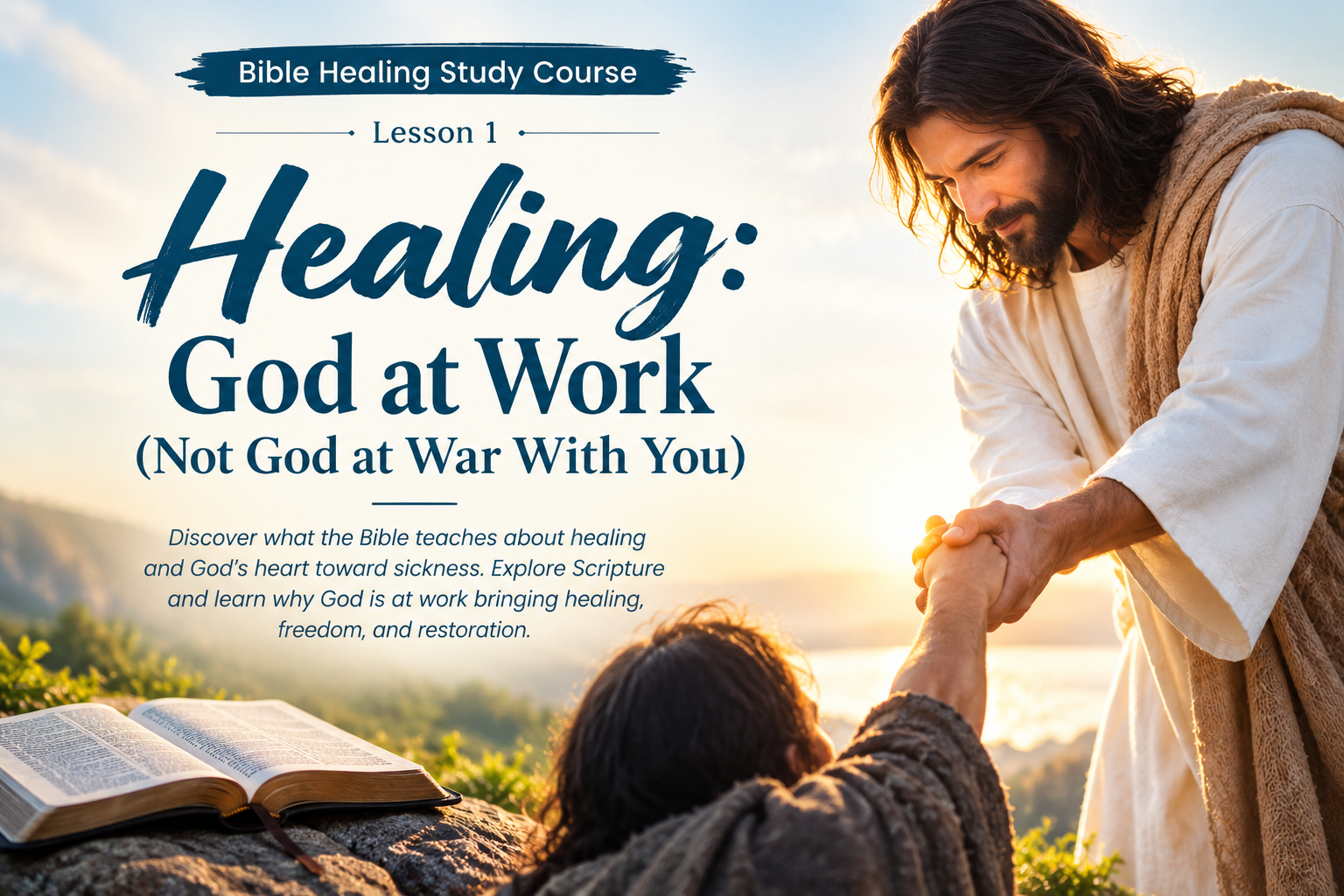
“God sent this sickness for a reason,” have you ever heard someone say that? It’s one of the most common things said in hospital rooms and prayer lines — and it’s worth asking a simple question: Did Jesus ever once do that to anyone?
Read all the healing stories in the Gospels. Jesus never turned away a sick person and said, “Sorry, this one’s from My Father — you’ll have to carry it a little longer. He never withheld healing to make a point. He never said any sickness that came to Him was “God’s will.” Not a single time.
And that is more important than it sounds because of one simple truth Jesus said about Himself:
John 14:9-10: 9 Jesus said to him, “Have I been with you so long, and yet you have not known Me, Philip? He who has seen Me has seen the Father; so how can you say, ‘Show us the Father’? 10 Do you not believe that I am in the Father, and the Father in Me? The words that I speak to you I do not speak on My own authority; but the Father who dwells in Me does the works.
If you want to know what God is really like, you don’t have to guess. You look at Jesus.
If You Want to See God at Work, Watch Jesus
(Bible Healing Study) Would you like to know God’s will? Look at Jesus, He is the will of God on the move. And what did that look like in reality?
Acts 10:38 how God anointed Jesus of Nazareth with the Holy Spirit and with power, who went about doing good and healing all who were oppressed by the devil, for God was with Him.
Notice how they are paired, doing good and healing. Jesus didn’t go around making people sick. He went to work freeing people.
This is where it is theologically significant. Much of the brokenness we see in creation—sickness, decay, disaster—did not begin with God’s design. It came in through the Fall, when Adam’s sin opened the door for a curse to work on the earth. That story about how we started is forgotten so people end up blaming God for things He never wrote—car accidents, diagnoses, deaths of loved ones, even storms and earthquakes (insurance companies still call natural disasters “acts of God”). But the Scripture points somewhere else.
The One Who Calms Storms, Not the One Who Sends Them
Picture the disciples in the Sea of Galilee, with a storm raging around their small craft, Jesus asleep in the stern. They wake Him up, terrified. He doesn’t say he’s sorry for the storm— He rebukes it, the same word that is used elsewhere for rebuking demons. That’s the picture. Jesus was calming a storm, not putting up with a message from His Father.
Why? For when Adam was given dominion over the earth (Psalm 89:11), he yielded that authority to the one he obeyed instead of God — and Scripture is clear about who assumed control:
2 Corinthians 4:4 calls Satan “the god of this world.”
That alone reframes a lot of casual theology. “God’s got everything under control.” But if that means God is currently running every event on planet earth exactly as He wants it, Scripture doesn’t support that. Not yet. There is coming a time when God will reign visibly and completely. That day is not yet here.
This is the very disconnect that keeps thoughtful people from faith. If God is in charge, and the world is full of suffering, either God is cruel or He’s not really in charge. The biblical answer is not that God is cruel. It’s just that the world’s brokenness has a different author, and God’s very nature—love—means that He can’t be the source of sickness and disaster in the first place.
“All That Were Oppressed of the Devil”
(Bible Healing Study) Turn back to Acts 10:38 and see carefully who Jesus healed. “all that were oppressed of the devil”. Not most. Not worth it. All. Behind every person Jesus healed, whether or not an evil spirit was visibly present, was a common enemy, the devil. The verse is not diplomatic.
That should prevent us from any theology in which God and the devil have switched places, and in which we are told that sickness is part of God’s mysterious plan and healing is an exception. The devil still the thief God still the healer No one switched places.
That’s exactly why the Great Commission includes healing as a normal expectation, not an exceptional one:
Mark 16:15,
15. And He said to them, “Go into all the world and preach the gospel to every creature.
17 And these signs will follow those who believe: In My name they will cast out demons; they will speak with new tongues;
18 they will take up serpents; and if they drink anything deadly, it will by no means hurt them; they will lay hands on the sick, and they will recover.”
Jesus didn’t say “lay hands on the sick that it’s My Father’s will to heal.” He just said “the sick.” No qualifier. And James gives the local church the same simple instruction:
James 5:14-15
14 Is anyone among you sick? Let him call for the elders of the church, and let them pray over him, anointing him with oil in the name of the Lord.
15 And the prayer of faith will save the sick, and the Lord will raise him up. And if he has committed sins, he will be forgiven.
“Is any sick among you” — meaning inside the church. If it were ever God’s will for believers to simply stay sick as some kind of spiritual assignment, this instruction wouldn’t make sense as written.
Clearing Up Common Misunderstandings
(Bible Healing Study) Some verses are taken to prove the opposite of what they teach. Each one worth unraveling:
2 Tim. 2:12, “If we suffer with him, we shall also reign with him. Suffer what, precisely? Look at the rest of the New Testament’s use of that word, and it’s persecution—opposition for standing on the Word—not disease. Paul had a lot of suffering for preaching healing and faith. He never said that disease was his badge of honor.
“Whom the Lord loveth He chasteneth” (Heb. 12:6). The Greek word behind “chasten” means to train or educate a child, the same root as our word “pedagogy. Loving discipline is never to cause disease. God doesn’t break a child’s leg to teach him, and no parent does.
Job “Proves” God Causes Disease. Look harder. The devil afflicted Job, with God’s permission, not God’s commission. There is a real difference in letting something happen and commanding it to happen. And Job himself called the door; “that which I greatly feared is come unto me” (Job 3:25) – fear opened a door the enemy walked through. The story’s ending (Job 42:10) shows God undoing Job’s suffering and doubling his blessings. That’s the real “work of God” in the account, not the affliction.
Healing Was Always the Plan — Even in the Old Testament
Some skeptics dismiss divine healing as a New Testament add-on. Bible says otherwise. Just as Israel crossed the Red Sea, God put this promise in the covenant:
Exodus 15:26 …..I will put none of the diseases on you which I have brought on the Egyptians. For I am the Lord who heals you.”
and again
Exodus 23:25-26 — “…I will take sickness away from the midst of thee… the number of thy days I will fulfil.”
The Psalms — Israel’s own songbook — repeat the same theme:
Psalm 103:3 Who forgives all your iniquities, Who heals all your diseases,
Psalm 107:19-20 Then they cried out to the Lord in their trouble, And He saved them out of their distresses. He sent His word and healed them, And delivered them from their destructions.
If healing wasn’t God’s character in the old covenant (which Hebrews says was inferior to the one believers now have [Heb. 8:6]), it’s hard to make the case that it disappeared under a better one. Paul makes the bridge explicit What happened to Israel was written “for our admonition” (1 Cor. 10:11) and “for our learning” (Rom. 15:4) Meaning promises like Deuteronomy 7:13-15, prosperity, health, no barrenness, no premature loss, weren’t just history. They were patterns for the church to interpret as personal instruction.
The Point of This Lesson
(Bible Healing Study) None of this is about denying the existence of sickness or minimizing anyone’s suffering. It’s knowing where it is coming from so we can pray right about it. Scripture invariably describes God as the one who takes away sickness, not the one who inflicts it, and Jesus, “the exact representation of the Father,” never did otherwise.
Questions for Reflection
- If you want to know what God is like, who should you look at?
- Who is the author of storms, floods, earthquakes, and all other catastrophes?
- When Satan is finally eliminated from the earth, what kinds of things won’t exist anymore?
- What two things make it impossible to accept the teaching that sickness and disease are from God?
- What does the word “chasten” mean?
- In Second Corinthians 12:7, what did Paul tell us his “thorn in the flesh” was?
- For whose benefit was Deuteronomy 7:13-15 written?
- What do the Greek and Hebrew words translated “salvation” imply?
- How did the children of Israel take themselves out from under the protection of their covenant?
- How do we know that it’s God’s will that we be healed?